
My parents came to visit me recently. I don’t currently live near my parents so they are not able to visit often. This time they came to help me out on some projects and I am very thankful of that. However, they are getting older and I would like them to enjoy themselves every once in a while. I feel that they work a lot and they do what is interesting to them but to me, some times it just looks like work. Relaxing is sitting around, doing some sport, seeing the sights and well, playing board games.
 While they were here, they were able to do some touristy things but, they have been here enough that the standard first time touristy stuff has already been done.
Anyway, to get to my point, they are what I would call a casual gamer. They are familiar with the games that a lot of people know but that is about it. One game that we have played over the years is a game called Trumps. We have found variations to play this game with people ranging from two to eight. Basically a 52 card poker deck trick taking game such as hearts or spades. Depending on the variation would determine the trump suit. This was a game that was commonly played at some family gatherings.
Bidder’s Trumps. This game takes place over the course of 10-16 rounds depending on player count. In the first six to eight rounds you are dealt a similar number of hidden card or cards. A random person is chosen to go first. Each person in turn order will then bid the number of tricks they think they will win and this number is written down. Then the first person will play a card. After everyone plays a card this is called one trick. The person with the highest card wins unless a trump suit is played. In Bidder’s Trumps, hearts are always the trump suit. A trump card can only be played if you don’t have any cards left or you can’t play a card with the same suit that the first person played. After all the card in hand are 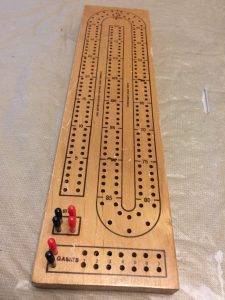 played, each person will check to see if they made their bid. The twist to this game is you have to make exactly what you bid. Not over or not under. If you did not make your bid you lost the round. If you made your bid, you won the round. If you lost the round then a negative gets placed in front of your bid. If you won the round, a one gets placed in front of your bid. For example, if you bid zero and got zero tricks you get ten points. If you bid zero and you got one trick, you get minus zero points. In round two, you get two cards. Say, in round six you bid four and got four tricks, you get fourteen points. If you did not and lost, you get negative four points. In future rounds, when all the cards are out and each player has an equal number of cards, this will be the highest card count for rounds. In the next round, you get one less card until you are back to one card. Who ever has the highest number of points wins. Really fun casual game but can get a bit tense at the higher card count.
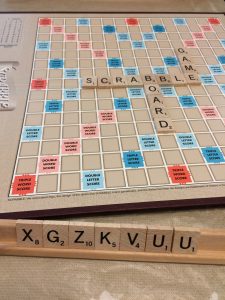
Recently my parents have been playing a lot of Scrabble. They play a co-op version of Scrabble and it is pretty fun. I’ve played a few times with them on this version and you play to just try and use all the letters and end on the same round. On this visit we were able to get in a few games of Scrabble on the last day. It was fun and we won both games.
 In earlier days during their visit, I tried to get them to play Scrabble and they said it was too much thinking. Yes, we were doing some things during the day that required thinking but it was too much of a brain burner. Hmm. This got me thinking. I look at a lot of reviews of board games from people and I feel that there is sometimes a disconnect. Perhaps that is not the right word but there is something not quite right. Board games have a lot of moving pieces, tokens and rules that you need to learn to play even the simplest of games.
With all the reviews I’ve watched from multiple reviewers, games seem to be placed into five different categories. Kids games. games that rely on roll and move, speed or dexterity. Light weight or family games. Games that rules are basic but there is some sort of strategy. Ticket to Ride, Carcassonne, Catan, Pandemic, Splendor. Mid weight and Heavy weight games. I’m not really sure where the line is drawn here but I would say that heavy weight games are games with very complex rules and take a long time to play. Twilight Imperium Three, Agricola, Twilight Struggle. I guess the mid-weight games are some where in between this level. The final category is the box store games or games you might grow up with. Both are not really a good definition. Monopoly, Scrabble, Chess, Checkers Risk.
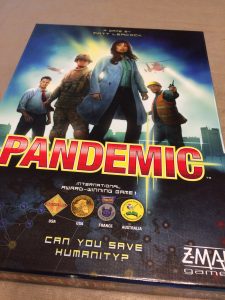 Here are just some of my experiences with non-gamers. I tried to teach my parents Pandemic. A family game. They kind of got it the first time but didn’t want to play again right away. The second time a few days later I was able to bring it out but was too much thinking. I think my mom liked it a bit more but has never asked about it again. I tried to teach my Dad how to play Dominion. Another family game. At the end of the game he kind of got the deck builder part but was way to much for him. We played scrabble on later dates. I tried to teach my Mom how to play Splendor. A family game. She seemed to like it as we played it multiple times in a row but has never asked about it again.
Here are a few more experiences. I tried to teach my cousin and family how to play King of Tokyo. A family game. They got it but one game was enough. I tried to teach my cousin and family how to play Codenames. A family game. Thre were two teams of four and I was one person on one team. Out of the seven new players, one person liked it and wanted to play again. I think the rest were done with it.
I feel that another category needs to be created between kids games and family weight games. Yes, I know there are party games but not everyone is outgoing or wants to play a party game. I think there are a lot of games that fit into this category. I know I mentioned Splendor but I think this is a bit less rules to learn and would be a good fit. Battle Line, Patchwork, Forbidden Island. Or, perhaps I’m asking too much and we are stuck with the old generation and modern gaming in the family category.

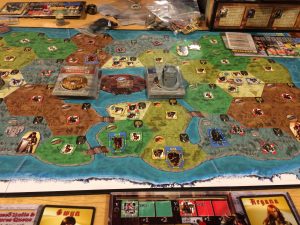
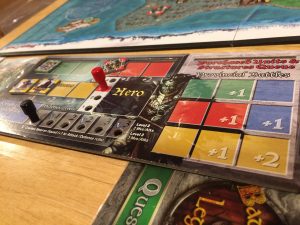 color group of territory, then you gain victory points.
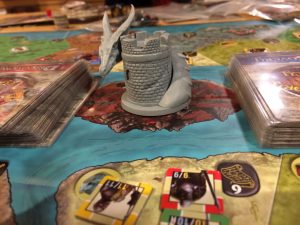 quality of this game is pretty good. I would say that you get a lot of little square chits on the board and they look pretty similar but they are different so it may be hard to tell what each one is. The design looks good and the player boards seem to work well if we ever put them together. There are a lot of pieces, cards and tokens. Overall, this game seems decent so far. Since there are so many games that fill this same similar style for me, I’m not sure if I would get it but it was fun to play and I would recommend trying it this seems interesting to you.