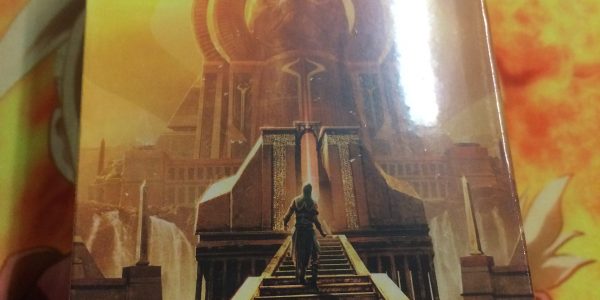
 In Magic, there are many ways to play this game. My favorite format is sealed deck and to be more specific pre-release sealed deck. Every few months Magic releases a new set of cards. Some cards can be reprints of older cards but most of the cards are new cards. The sets are grouped into blocks and now two sets consist of one block. Each block has some sort of theme that is grouped with that block. Amonkhet is the name of the newest Magic set and considered the first of the sets in the block. Amonkhet is the name of the world which is an Egyptian themed harsh desert planet. Magic designers have created a story of a group of planeswalkers. Planeswalkers are powerful people who have been gifted with the magic to travel to different worlds. These planeswalkers have formed an alliance and are hunting down Nicol Bolas who is a powerful elder dragon and is believed to be on Amonkhet.
 In the sealed deck format, players are given six booster packs and one special promo card. Using these randomly selected cards, the players will build a deck to play with against others. One of the reasons I enjoy this format is because everyone starts on a level playing field. Of course some cards are better then others and other people may get these cards but I think if you build your deck well and play well then you will do very good. It is about skill of what to include in your deck construction and the decisions that you make during the game that will get you wins.
There are some general rules to follow when building a sealed deck but this is not always the case and rules are meant to be broken. There is a minimum of 40 cards that you can include in your deck and I think you should stick to 40-41 cards to have a chance to draw your more powerful cards. Second is the amount of lands that you should include in your deck. 17 lands are the standard. Third is the amount of creatures you have in your deck. 14-17 creatures is standard. Fourth is your mana curve. You should have a somewhat bell curve of casting costs for things in your deck. Fifth is your removal. Having some sort of cards or abilities to kill creatures is a good thing. Sixth is synergy. Cards that work together to create a more powerful effect can be great to use on your side of the battlefield. These are not in any specific order in my opinion but if you have all of these in your deck, then I think you have created the best deck you can with your card pool.
I liked to create two color decks in the sealed deck format. A lot of times, generating mana is an issue. You may have a great spell or creature b ut you can’t cast it because you don’t have the right mana or even enough mana. When I started to open up my packs I saw that I had a lot of creatures in white with some removal. I saw some great creatures with abilities in black but not very many. But, there was also some removal. In Blue, I had two removal and less then six total creatures. Green had one removal, some synergy and not great creatures but also not bad. Red had one great creature, some average creatures and a great spell. In the end, I decided to go with a Red/Green hopefully aggression or aggro deck. I only had a few removals and I usually like those but I felt I had some good synergy and enough aggro creatures.
 Since I went to a midnight pre-release, the tournament was not completely full but there were about 35-45 people. There are four rounds of play and if your record is 2-2 then you can win prize packs. Each round you play 2/3 and continue to play others with the same record. My first opponent was playing a red/green/white deck. In game one, he did not do very much. Later in the game he brought out a few creatures and drew the game out but I won.
Hmmm. There is a new mechanic called exert which gives your creature some sort of bonus when attack and I had a few in my deck but it was not as fast as I thought it was going to be. In game two we stalled again mid game and then he brought out a Samut, Voice of the Dissent. Flash, double strike, vigilance, haste and give all other creatures haste. I didn’t have anything to deal with that and I lost. In game three I had to mulligan and was at a card disadvantage. I came out very strong. He decided to attack with all his creatures which brought me down to about ten life. He was at 10 and I had a fling in my hand but would not be able to deal lethal damage this turn. I attacked with all my creatures and brought out a blocker. He then Flashed in Samut during my end step, fought my creature with Green Cartouche of strength and killed me. I probably should have played more cautiously but it was a close fun game.
My deck broke some rules of my general deck construction. I was running 16 land and my mana curve was very low. I had four creatures that cost four and two double cards with the second side costing four but the initial card costing three. The rest of the cards I had were three casting cost and lower. It was not even a battle with my second opponent. She was playing a Green/Blue deck. I had two lands the first game and lost. In game two, I was able to draw some extra cards and had lots of red land, but had a hand full of green cards. I lost again. She had a great card called Sandwurm Convergence creating a 5/5 wurm token every turn and great mana fixers. She also had multiple Naga Oracle which was a card I had but kind of dismissed its abilities in my initial deck construction. This is an awesome card in sealed.
 Ok. 0-2. If I win the next two games I might get something. My next opponent had a Black/Blue deck. In the first game, We were even in the beginning to mid game. He had an Edifice of Authority that stalled my creatures from attacking. I was finally able to get in my Heat-Piercer Manticore and sacked a four toughness creature with Honed Khopesh to deal five damage to him. Then I put Honed Khopesh on the Manticore and casted a fling at him. In game two, I saw Edifice of Authority again and stalled out. He also had some cycling synergy with Pitiless Vizier giving it indestructible and Rhonas’s Monument giving +2/+2 to a creature when a creature enters the battlefield. I lost game two. Game three was a complete repeat of game two and I lost.
0-3. Of course my last opponent dropped from the tournament because you can’t win any prizes with a record of 1-3 and it was 4 AM. I stuck around to watch a friend finish his last match. It was really fun to see two 2-1 decks going at it. In the end of that round, my friend was able to win and finished with a 3-1 record. Of course he broke the rules as well with a five color deck, but he had multiple mana fixers.
After getting some sleep, I re-made my deck with the card pool I had. I made a Black/White/Blue deck…all the colors I didn’t play? More removal and a better mana curve. I think this deck would have been a lot better for me. Over all, I just didn’t do very well this time. I don’t even recall having a record with no real wins. I usually average a 2-2 record and an occasional 3-1. I think only playing pre-releases is getting to me and I am getting a bit rusty. Unfortunately for Magic, there are many other games that I want to play as well so it will probably continue to be this way. I enjoyed my time and it is an interesting set. Very nostalgic for me as I see a lot of cards I remember from long ago.

 Every few months or so, I’m really not sure on the timeline, a new set is released. Each set is based on a theme such as an anime show, video game or manga. Manga’s are basically Japanese comic books. You will buy cards to create a 50 card deck based on your theme. Some popular themes are Attack on Titan, Sword Art Online, Kill la Kill, KanColle, Disgaea and so on. Since it is collectable, they have their own rarity system of cards. The most rare cards are signed by the artist or voice actor. The game takes about 30-45 minutes to play and play is one on one. Weiss is the Cute side and Schwarz is the fighting side. It really doesn’t matter what side you play.
 more strategy but if you like the themes of sets coming out it is pretty awesome to be able to play some of your favorite characters. I would say that there are two main differences. One is how damage is dealt and the game winning condition. Two are the climax cards.
 A few months later I found a local game store that sold this game and found out they held weekly tournaments on Sundays. Sundays are really busy for me. I have multiple weekly events or things that I do and one is on Thursdays and one is on Sundays. Those are my two days that I have multiple things I want to do. Weiss Schwarz fell aside. I found I was always browsing the website or looking at cards to buy every once in a while but never really played again.
 There are four colors that you can choose from and this was a three color deck. Green, Yellow and Red. The main two characters were Archer as Gilgamesh and Rider as Alexander the Great. My first opponent was a guy playing a Japanese deck of…hmmm I don’t remember what theme he was using. This game is printed in America in English but more sets are printed in Japan in Japanese. In the first few rounds I kept drawing my level two and three cards an no level zero cards so I couldn’t play them. I got to level one pretty quick. I was able to come back with a few nicely timed climax cards. Then we were both at level three and he was able to heal some damage that I gave him and cancelled a five soul attack that I did with a climax card. He won. I thought it was a pretty close game. I think if I had drawn just a few level zero characters in the beginning it would have been better.
 playing the evil side which is KanColle: Fleet in the Deep Blue Sea, I think. On my first turn, I forgot to clock. Card disadvantage right from the start. I think it was fairly even in the begining but then I got to level one. To play a card, you need to have that same card color in your clock or as your level card. When you get to the next level, you choose a card to become your level card and put the rest of your cards in your waiting room or out of play. I chose a red card and I had a hand full of green cards. This went on for two turns. When I got to level two I got a level zero card that I could play. Since he was at level one, all of his characters were stronger then my level zero character. When you play characters you can have up to five characters out in play at one time. There are three characters in the front who attack and two support characters. If your opponent does not have any characters in front of them, the character has more soul and adds more clock. I had one or no characters in play and he had five for most of the game. When I got to level three, I finally had the right colors out but I didn’t have the stock to play any of them since the main way you gain stock is from attacking. I lost horribly, but it was fun to play.
 Magic: The Gathering. What can I say about this game. For me, there is a love/hate relationship with this game. It is the game that first got me into modern board gaming, or card gaming over 20 years ago. It is a game that after 20 years, is still going strong by gaining new players, pushing the boundaries for coming up with new and creative ideas and could arguable be the game that on its own, keeps the board gaming hobby alive.
 can then use these creatures and command them to attack or defend attacks from your opponent. Each game can take an average time of 10-60 minutes to play. There are also many formats that you can play that range from 2-infiate number of players but it is normal for no more then about six players.
 pells or creatures you will need to create mana. This typically comes from your lands. Your lands are generally what was listed above such as Plains, Swamps, Mountains, Islands or Forests. Lands are free to play and you will want to put those into your deck. However, you can only play one land a turn so your more powerful creatures and spells will not be able to come out until later in the game. If, for example, you wanted to cast a creature that you had in your hand that cost four mana, you might wait till turn four. Hopefully you were able to play a land on each of your turns. Then you will turn your four lands sidewards. This is called Tap. Tap means to turn a card from right side to sideways indicating that it is being used or spent. In Magic, at the beginning of your turn you will Untap your cards that are tapped so you can use their abilities again. Tapping something that first came out in Magic and since they copyrighted the term, other games have to use a different term.
